Selected Publications
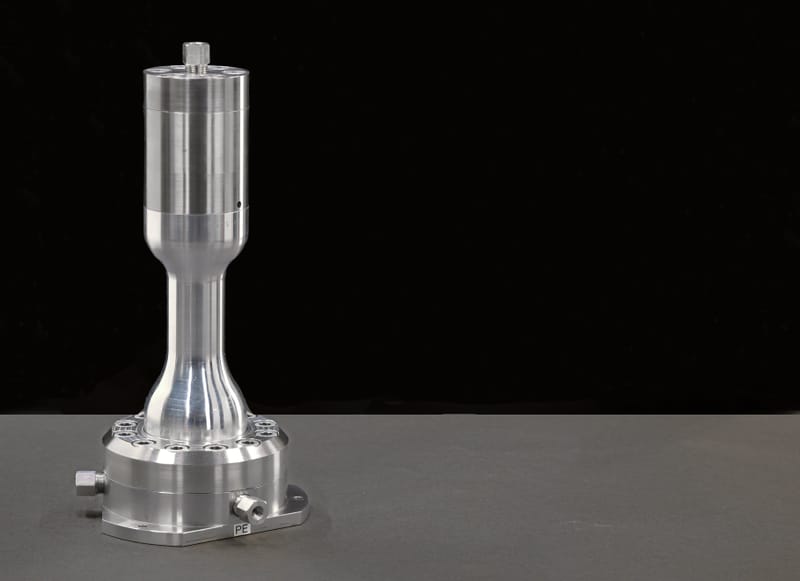
A new apparatus for in-situ X-ray imaging of deformation experiments at confining pressures of up to 100 MPa, integrating operando permeability measurements, reactive fluid injection, and supercritical carbon sequestration capabilities.
Read More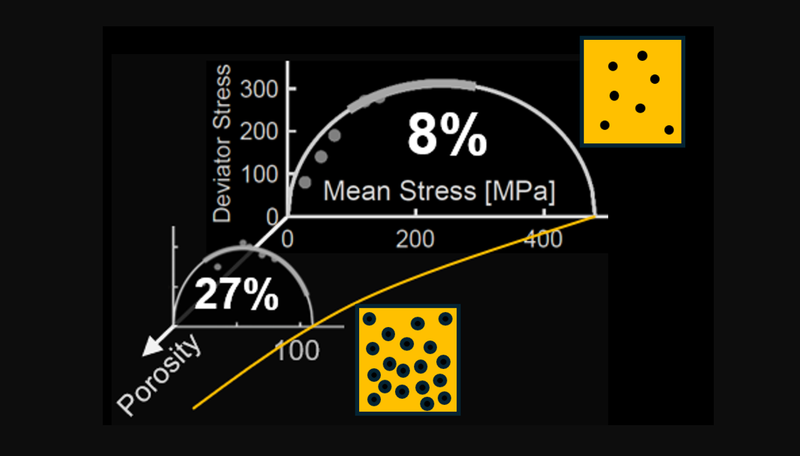
A predictive model capable of extrapolating brittle-ductile transition and strain localization behavior across a porosity range of 8% to 27%, validated using data from more than 15 sandstones.
Read More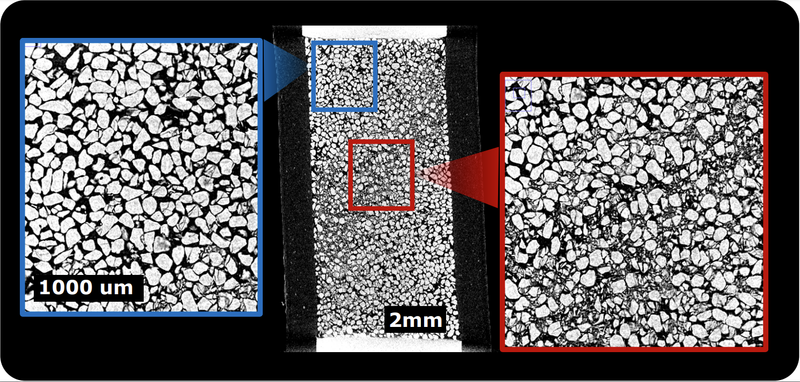
Laboratory study providing an in-depth analysis of the micro-mechanical processes (i.e., contact sliding and grain breakage) that drive yielding and deformation mechanism of sand deformed in the ductile regime.
Read More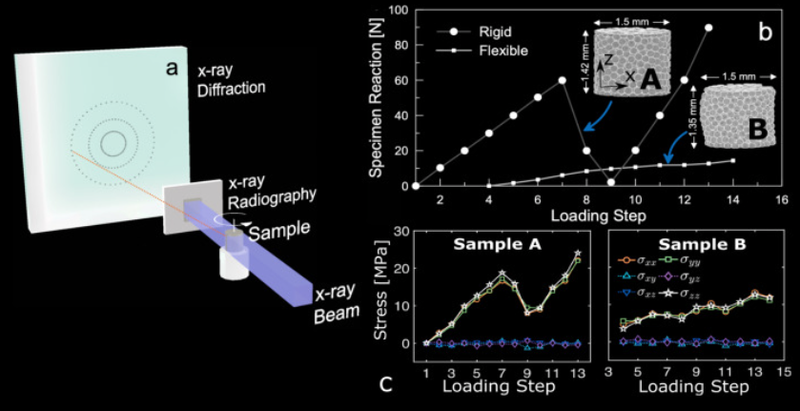
Based on X-ray tomography and X-ray diffraction measurements, this fundamental study investigates the transition from heterogeneous to homogenous scale revealing scale hierarchy in geometry, stress and energy dissipation
Read More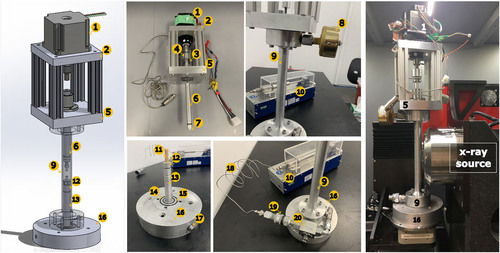
Technical paper reporting, with demonstrations, features of a new load-frame designed by the Authors and installed at Johns Hopkins University to test geomaterials under high pressures with the aid of in-house and synchrotron x-ray tomography.
Read More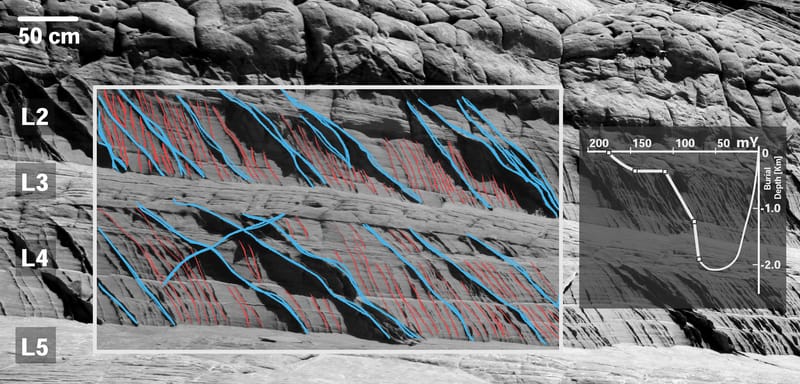
Numerical investigation into the origin, causes, and sequences of complex compaction band structures observed in the dessert of Utah, combining geological history, field stratigraphy, material theories, and finite element computations.
Read More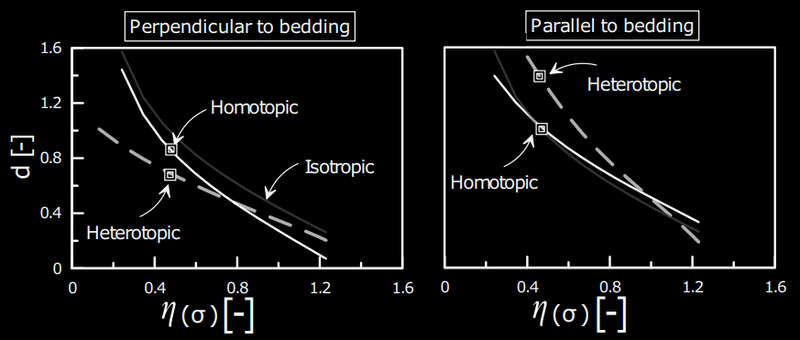
Laboratory investigation combined with theoretical developments to explain the divergent anisotropic responses in yielding-stresses and post-yielding deformation in the highly porous rock of Maastricht Tuffeau.
Read More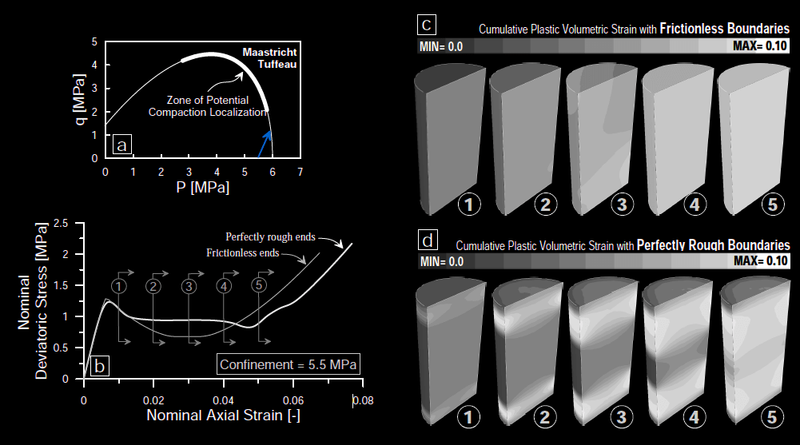
The role of boundary effects in promoting heterogeneous deformation fields is assessed in the context of examining the bias that boundary friction could introduce on the characterization of compaction localization in predominantly softening and hardening porous rocks.
Read More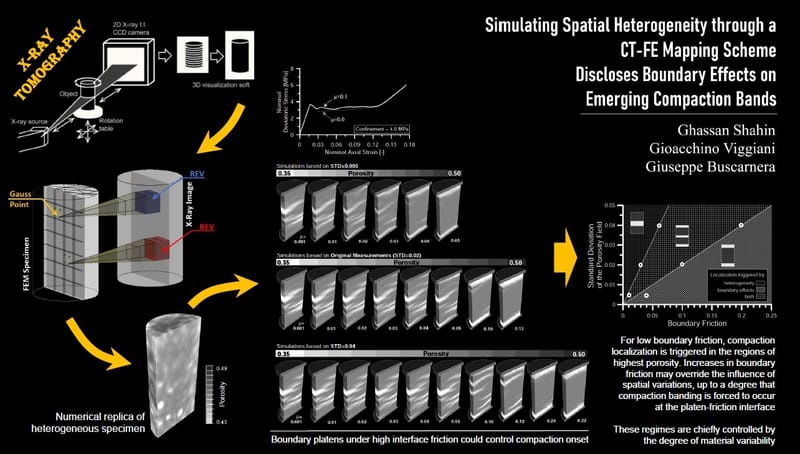
The natural heterogeneity of porous rocks is integrated in numerical simulations to quantify its interplay with interfering boundary effects in the context of the triggering and the propagation of compaction band.
Read More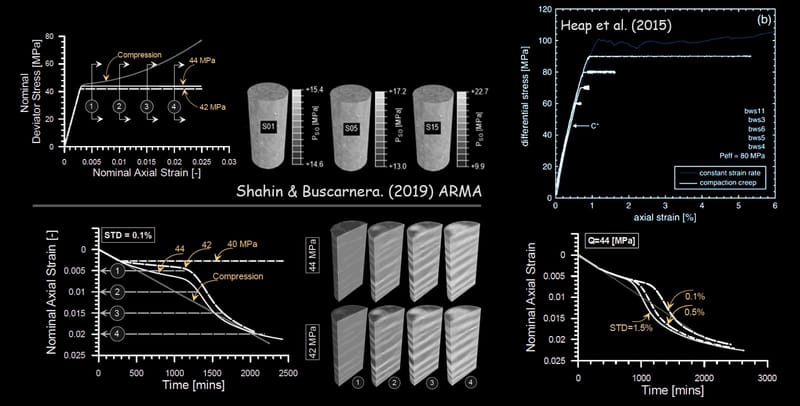
Studies of the role played by spatial heterogeneities in triggering delayed compaction bands under moderated levels of creep stress.
Read More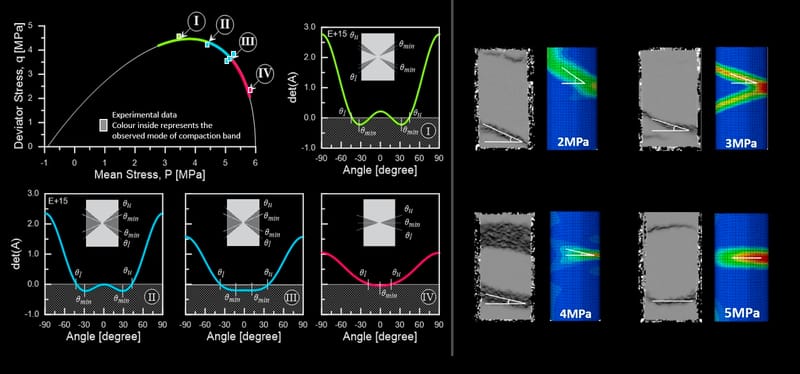
Illustration of elastoplastic modeling and validation of compaction banding in a highly-porous limestone tested mechanically in concurrence with in-situ x-ray computed tomography.
Read More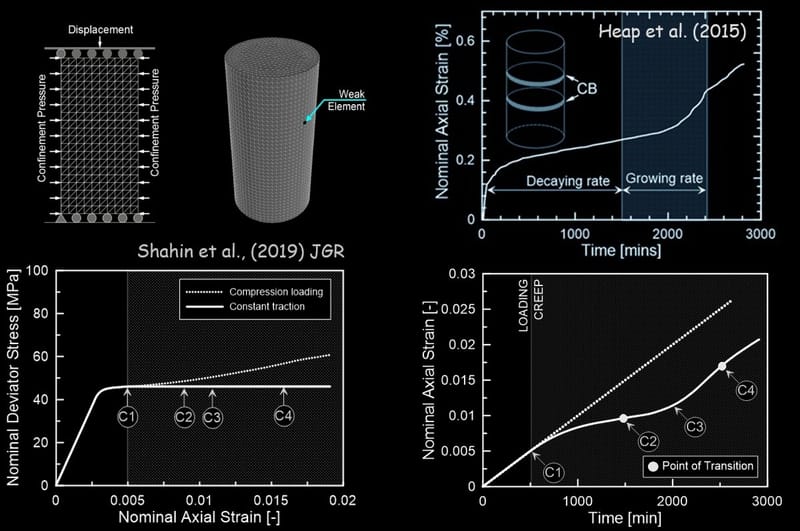
Constitutive modeling and theoretical developments of instability indices for compaction creep in porous rocks susceptible to strain localization, and the example here is: Bleurswiller sandstone.
Read More