Metamodel for Porous Rock: Porosity and Water-Weakening Controls on Brittle-Ductile Transition in Sandstones
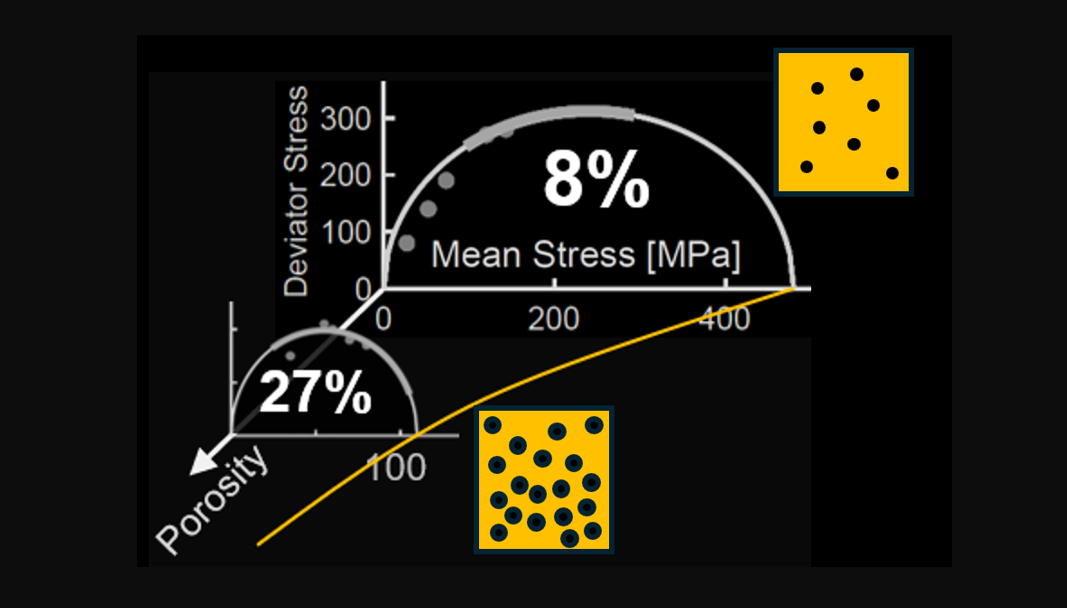
Porosity and water exert first-order controls over the mechanical properties of sandstones. Investigations quantifying the influence of these controls have been predominantly focused on strength metrics and have rarely been extended to the full range of mechanical properties of sandstones. In this study, we examine and quantify the influence of porosity and water-saturation on the broad spectrum of brittle-ductile and localized-diffuse deformation transitions in sandstones, employing a constitutive modeling approach. More than 15 natural and synthetic sandstones are simulated and their constitutive properties are characterized within a reduced, strain-hardening and multi-variable elastoplastic framework. Sensitivity analyses show that only a few constitutive parameters vary systematically with porosity and water-saturation. Once calibrated for a specific material, the hydrostatic yield pressure is strongly linked to porosity, in agreement with prior studies. Porosity appears to contribute primarily to material hardening through a universal relationship (at least within the class of materials investigated in this study), whereas other mineralogical and morphological parameters exert only secondary-order effects. Water saturation proportionally reduces both elastic stiffness and hydrostatic yield pressure. In contrast, parameters controlling yield-surface and plastic-potential shape, and strain softening, show no detectable dependence on porosity or water-saturation.Observed trends provide the foundation for constructing a sandstone metamodel that is applicable over a porosity range of approximately 10–30% and under nominally dry and nominally water-saturated conditions. A metamodel is a high-order mathematical structure that generates constitutive models as a function of measurable states (here initial porosity and water-saturation). The proposed sandstone metamodel reproduces yield response, brittle-to-ductile transition, dilatancy evolution, and strain-localization modes with accuracy deemed satisfactory for constitutive modeling across the explored range of initial porosity and water-saturation conditions.Our metamodel facilitates the systematic integration of borehole sampling, high-resolution reservoir geophysical imaging, and large-scale geomechanical simulations, thereby improving the accuracy of deformation predictions in heterogeneous reservoirs pertinent to geological carbon storage and geothermal energy production.